4.3.1 Right Angle Identities
$$\sin^2(\theta)+\cos^2(\theta)=1$$
$$\tan^2(\theta)+1=\sec^2(\theta)$$
$$\cot^2(\theta)+1=\csc^2(\theta)$$
Proofs
In each case, given the
right angle theorem, divide by the hypotenuse, $x$ component, and $y$ component respectively
$$\frac{h^2=x^2+y^2}{h^2}\medspace\to\medspace 1=\frac{x^2}{h^2}+\frac{y^2}{h^2}$$
$$\frac{h^2=x^2+y^2}{x^2}\medspace\to\medspace \frac{h^2}{x^2}=1+\frac{y^2}{x^2}$$
$$\frac{h^2=x^2+y^2}{y^2}\medspace\to\medspace \frac{h^2}{y^2}=\frac{x^2}{y^2}+1$$
In each case, substitute the
right angle definition
4.3.2 Law of Sines
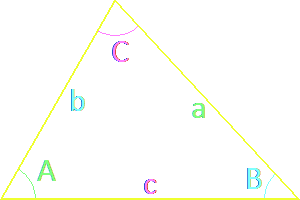
$$\frac{\sin(A)}{a}=\frac{\sin(B)}{b}=\frac{\sin(C)}{c}$$
Proof
Given the
triangle area, substitute the height orthogonal to each base with its
right angle definition for sine

$$\frac{1}{2}·b·c·\sin(A)=\frac{1}{2}·c·a·\sin(B)=\frac{1}{2}·a·b·\sin(C)$$
Multiply by $2/(a·b·c)$
4.3.3 Law of Cosines
$$c^2=a^2+b^2-2·a·b·\cos(C)$$
Proof
Insert an orthogonal line to $c$ to represent the height of the triangle, dividing $c$ as $c_1$ and $c_2$
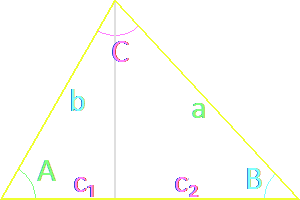
Find $c_1$ and $c_2$ by taking the cosine of $A$ and $B$
$$\cos(A)=\frac{c_2}{b}\qquad\cos(B)=\frac{c_1}{a}$$
Solve for $c_1$ and $c_2$
$$c_2=b·\cos(A)\qquad c_1=a·cos(B)$$
Add $c_1$ to $c_2$ for $c$
$$c_2+c_1=c=b·\cos(A)+a·cos(B)$$
Multiply by $c$
$$c^2=b·c·\cos(A)+a·c·cos(B)$$
Repeat the process for the other two sides
$$a^2=c·a·\cos(B)+b·a·cos(C)$$
$$b^2=a·b·\cos(C)+c·b·cos(A)$$
Add the last two equations and subtract the first
$$a^2+b^2-c^2=c·a·\cos(B)+b·a·cos(C)+a·b·\cos(C)+c·b·cos(A)-b·c·\cos(A)-a·c·cos(B)$$
Simplify
$$a^2+b^2-c^2=2·a·b·\cos(C)$$
Isolate $c^2$
4.3.4 Sum & Difference Identities
$$\sin(a\pm b)=\sin(a)·\cos(b)\pm\cos(a)·\sin(b)$$
$$\cos(a\pm b)=\cos(a)·\cos(b)\mp\sin(a)·\sin(b)$$
$$\tan(a\pm b)=\frac{\tan(a)\pm\tan(b)}{1\mp\tan(a)·\tan(b)}$$
$$\cot(a\pm b)=\frac{\cot(a)·\cot(b)\mp1}{\cot(b)\pm \cot(a)}$$
Proof of Sine & Cosine
On the
unit circle, plot points for $(1,0)$, and for the angles $b$, $a-b$, and $a$ respectively in a positive rotation

Determine the coordinates of each point given their angles using the unit circle definitions

The distances displayed are equal to each other. Use the
distance formula for each set equal to each other.
$$\sqrt{\big(1-\cos(a-b)^2\big)^2+\big(0-\sin(a-b)^2\big)^2}=\sqrt{\big(\cos(b)-\cos(a)\big)^2+\big(\sin(b)-\sin(a)\big)^2}$$
Square
$$\big(1-\cos(a-b)^2\big)^2+\big(0-\sin(a-b)^2\big)^2=\big(\cos(b)-\cos(a)\big)^2+\big(\sin(b)-\sin(a)\big)^2$$
Expand the left
$$1-2·\cos(a-b)+\cos^2(a-b)+\sin^2(a-b)=\big(\cos(b)-\cos(a)\big)^2+\big(\sin(b)-\sin(a)\big)^2$$
Use the
right angle identity to simplify to one
$$1-2·\cos(a-b)+1=\big(\cos(b)-\cos(a)\big)^2+\big(\sin(b)-\sin(a)\big)^2$$
Expand the right
$$2-2·\cos(a-b)=\cos^2(b)-2·\cos(a)·\cos(b)+\cos^2(a)+\sin^2(b)-2·\sin(a)·\sin(b)+\sin^2(a)$$
Use the right angle identity to simplify to 1 in two instances
$$2-2·\cos(a-b)=-2·\cos(a)·\cos(b)-2·\sin(a)·\sin(b)+2$$
Subtract 2
$$-2·\cos(a-b)=-2·\cos(a)·\cos(b)-2·\sin(a)·\sin(b)$$
Divide by $-2$
$$\cos(a-b)=\cos(a)·\cos(b)+\sin(a)·\sin(b)$$
Substitute $-b$ for $b$
$$\cos\big(a-(-b)\big)=\cos(a)·\cos(-b)+\sin(a)·\sin(-b)$$
Apply the
even/odd identities
$$\cos(a+b)=\cos(a)·\cos(b)-\sin(a)·\sin(b)$$
Substitute $\pi/2-(a+b)$ for $a+b$ and $\pi/2-a$ for $a$
$$\cos\bigg(\frac{\pi}{2}-a-b\bigg)=\cos\bigg(\frac{\pi}{2}-a\bigg)·\cos(b)-\sin\bigg(\frac{\pi}{2}-a\bigg)·\sin(b)$$
Apply the
complimentary angle identities
$$\sin(a-b)=\sin(a)·\cos(b)-\cos(a)·\sin(b)$$
Substitute $-b$ for $b$
$$\sin\big(a-(-b)\big)=\sin(a)·\cos(-b)-\cos(a)·\sin(-b)$$
Apply the even/odd identities
$$\sin(a+b)=\sin(a)·\cos(b)+\cos(a)·\sin(b)$$
Proof of Tangent
Substitute tangent for its
sine/cosine cofunction
$$\tan(a\pm b)=\frac{\sin(a\pm b)}{\cos(a\pm b)}$$
Substitute the sum & difference identities for sine and cosine
$$\tan(a\pm b)=\frac{\sin(a)·\cos(b)\pm\cos(a)·\sin(b)}{\cos(a)·\cos(b)\mp\sin(a)·\sin(b)}$$
Divide the numerator and denominator by $\cos(a)·\cos(b)$
$$\tan(a\pm b)=
\frac{\big(\sin(a)·\cos(b)\pm\cos(a)·\sin(b)\big)/\big(\cos(a)·\cos(b)\big)}
{\big(\cos(a)·\cos(b)\mp\sin(a)·\sin(b)\big)/\big(\cos(a)·\cos(b)\big)}$$
Cancel like terms
$$\tan(a\pm b)=\frac{\sin(a)/\cos(a)\pm\sin(b)/\cos(b)}{1\mp\big(\sin(a)·\sin(b)\big)/\big(\cos(a)·\cos(b)\big)}$$
Substitute the
tangent cofunction for the sines/cosines
Proof of Cotangent
Substitute cotangent for its
cosine/sine cofunction
$$\cot(a\pm b)=\frac{\cos(a\pm b)}{\sin(a\pm b)}$$
Substitute the sum & difference identities for cosine and sine
$$\cot(a\pm b)=\frac{\cos(a)·\cos(b)\mp\sin(a)·\sin(b)}{\sin(a)·\cos(b)\pm\cos(a)·\sin(b)}$$
Divide the numerator and denominator by $\sin(a)·\sin(b)$
$$\cot(a\pm b)=
\frac{\big(\cos(a)·\cos(b)\mp\sin(a)·\sin(b)\big)/\big(\sin(a)·\sin(b)\big)}
{\big(\sin(a)·\cos(b)\pm\cos(a)·\sin(b)\big)/\big(\sin(a)·\sin(b)\big)}$$
Cancel like terms
$$\cot(a\pm b)=\frac{\big(\cos(a)·\cos(b)\big)/\big(\sin(a)·\sin(b)\big)\mp 1}{\cos(b)/\sin(b)\pm\cos(a)/\sin(a)}$$
Substitute the
cotangent cofunction for the cosines over sines
4.3.5 Product-to-Sum Identities
$$2·\sin(a)·\sin(b)=\cos(a-b)-\cos(a+b)$$
$$2·\cos(a)·\cos(b)=\cos(a-b)+\cos(a+b)$$
$$2·\sin(a)·\cos(b)=\sin(a+b)-\sin(a-b)$$
$$2·\cos(a)·\sin(b)=\sin(a+b)-\sin(a-b)$$
Proofs
In each case, substitute the
sum and difference identities for the terms on the right, and simplify
4.3.6 Sum-to-Product Identities
$$\sin(a) \pm \sin(b)=2·\sin\bigg(\frac{a \pm b}{2} \bigg)·\cos\bigg(\frac{a \mp b}{2} \bigg)$$
$$\cos(a)+\cos(b)=2·\cos\bigg(\frac{a+b}{2} \bigg)·\cos\bigg(\frac{a-b}{2} \bigg)$$
$$\cos(a)-\cos(b)=-2·\sin\bigg(\frac{a+b}{2} \bigg)·\sin\bigg(\frac{a-b}{2} \bigg)$$
Proofs
Using the angles from the
product-to-sum identities, let $a=(u+v)/2$ and $b=(u-v)/2$ so that
$$a+b=\frac{u+v}{2}+\frac{u-v}{2}=u$$
$$a-b=\frac{u+v}{2}-\frac{u-v}{2}=v$$
Substitute the terms with $a$ and $b$ for the terms with $u$ and $v$ into the
product-to-sum identities
4.3.7 Double Angle Identities
$$\sin(2·\theta)=2·\sin(\theta)·\cos(\theta)$$
$$\csc(2·\theta)=\frac{1}{2}·\sec(\theta)·\csc(\theta)$$
$$\cos(2·\theta)=\cos^2(\theta)-\sin^2(\theta)$$
$$\sec(2·\theta)=\frac{1}{\cos^2(\theta)-\sin^2(\theta)}$$
$$\tan(2·\theta)=\frac{2·\tan(\theta)}{1-\tan^2(\theta)}$$
$$\cot(2·\theta)=\frac{\cot^2(\theta)-1}{2·\cot(\theta)}$$
Proofs
In each case, start with the
sum identity for the corresponding function using the same angle for both variables. For secant and cosecant, use $\cos(a\pm b)^{-1}$ and $\sin(a\pm b)^{-1}$ respectively.
Example
The
circle segment area expression can be simplified by using the sine double angle identity
$$\frac{r^2}{2}·\Big(\theta-2·\sin\Big(\frac{\theta}{2}\Big)·\cos\Big(\frac{\theta}{2}\Big)\Big)$$
$$\therefore\frac{r^2}{2}·\big(\theta-\sin(\theta)\big)$$
4.3.8 Half Angle Identities
$$\sin\bigg(\frac{\theta}{2}\bigg)=\pm\sqrt{\frac{1-\cos(\theta)}{2}}$$
$$\cos\bigg(\frac{\theta}{2}\bigg)=\pm\sqrt{\frac{1+\cos(\theta)}{2}}$$
$$\tan\bigg(\frac{\theta}{2}\bigg)=\pm\sqrt{\frac{1-\cos(\theta)}{1+\cos(\theta)}}$$
$$\cot\bigg(\frac{\theta}{2}\bigg)=\pm\sqrt{\frac{1+\cos(\theta)}{1-\cos(\theta)}}$$
In each case, only one solution exists, and signs must be determined by the quadrant of $\theta/2$
Proof of Sine
Given the
cosine double angle identity, use $\theta$ for $2·\theta$ and $\theta/2$ for $\theta$
$$\cos(\theta)=\cos^2\bigg(\frac{\theta}{2}\bigg)-\sin^2\bigg(\frac{\theta}{2}\bigg)$$
Substitute the
right angle identity for $\cos^2(\theta)$
$$\cos(\theta)=1-2·\sin^2\bigg(\frac{\theta}{2}\bigg)$$
Subtract 1
$$\cos(\theta)-1=-2·\sin^2\bigg(\frac{\theta}{2}\bigg)$$
Divide by –2
$$\frac{1-\cos(\theta)}{2}=\sin^2\bigg(\frac{\theta}{2}\bigg)$$
Take the square root
Proof of Cosine
Given the
cosine double angle identity, use $\theta$ for $2·\theta$ and $\theta/2$ for $\theta$
$$\cos(\theta)=\cos^2\bigg(\frac{\theta}{2}\bigg)-\sin^2\bigg(\frac{\theta}{2}\bigg)$$
Substitute the
right angle identity for $\sin^2(\theta)$
$$\cos(\theta)=2·\cos^2\bigg(\frac{\theta}{2}\bigg)-1$$
Add 1
$$1+\cos(\theta)=2·\cos^2\bigg(\frac{\theta}{2}\bigg)$$
Divide by 2
$$\frac{1+\cos(\theta)}{2}=\cos^2\bigg(\frac{\theta}{2}\bigg)$$
Take the square root
Proof of Tangent
Divide the sine half angle identity by the cosine half angle identity
$$\bigg|\sin\bigg(\frac{\theta}{2}\bigg)\bigg|\bigg/\bigg|\cos\bigg(\frac{\theta}{2}\bigg)\bigg|=\sqrt{\frac{1-\cos(\theta)}{2}}\bigg/\sqrt{\frac{1+\cos(\theta)}{2}}$$
Substitute sine/cosine for its tangent
cofunction
$$\bigg|\tan\bigg(\frac{\theta}{2}\bigg)\bigg|=\sqrt{\frac{1-\cos(\theta)}{2}}\bigg/\sqrt{\frac{1+\cos(\theta)}{2}}$$
Factor the root
$$\bigg|\tan\bigg(\frac{\theta}{2}\bigg)\bigg|=\sqrt{\frac{1-\cos(\theta)}{2}\bigg/\frac{1+\cos(\theta)}{2}}$$
Simplify
Proof of Cotangent
Divide the cosine half angle identity by the sine half angle identity
$$\bigg|\cos\bigg(\frac{\theta}{2}\bigg)\bigg|\bigg/\bigg|\sin\bigg(\frac{\theta}{2}\bigg)\bigg|=\sqrt{\frac{1+\cos(\theta)}{2}}\bigg/\sqrt{\frac{1-\cos(\theta)}{2}}$$
Substitute cosine/sine for its cotangent
cofunction
$$\bigg|\cot\bigg(\frac{\theta}{2}\bigg)\bigg|=\sqrt{\frac{1+\cos(\theta)}{2}}\bigg/\sqrt{\frac{1-\cos(\theta)}{2}}$$
Factor the root
$$\bigg|\cot\bigg(\frac{\theta}{2}\bigg)\bigg|=\sqrt{\frac{1+\cos(\theta)}{2}\bigg/\frac{1-\cos(\theta)}{2}}$$
Simplify
4.3.9 Square Identities
$$\sin^2(\theta)=\frac{1-\cos(2·\theta)}{2}$$
$$\cos^2(\theta)=\frac{1+\cos(2·\theta)}{2}$$
$$\tan^2(\theta)=\frac{1-\cos(2·\theta)}{1+\cos(2·\theta)}$$
$$\cot^2(\theta)=\frac{1+\cos(2·\theta)}{1-\cos(2·\theta)}$$
Proofs
In each case, start with the
half angle identity for the corresponding function, use $\theta$ for $2·\theta$ and $\theta/2$ for $\theta$, and square the equations
4.3.A Functions of Inverses 🔧
$$\tan\big(\cos^{-1}(x)\big)=\frac{\sqrt{1-x^2}}{x}$$
$$\sin\big(\cos^{-1}(x)\big)=\sqrt{1-x^2}$$
$$\sin\big(\tan^{-1}(x)\big)=\frac{x}{\sqrt{x^2+1}}$$
$$\cos\big(\tan^{-1}(x)\big)=\frac{1}{\sqrt{x^2+1}}$$
$$\cos\big(\sin^{-1}(x)\big)=\sqrt{1-x^2}$$
$$\tan\big(\sin^{-1}(x)\big)=\frac{x}{\sqrt{1-x^2}}$$
Proof of $\tan\big(\cos^{-1}(x)\big)$ and $\sin\big(\cos^{-1}(x)\big)$
Proof of $\sin\big(\tan^{-1}(x)\big)$ and $\cos\big(\tan^{-1}(x)\big)$
Proof of $\cos\big(\sin^{-1}(x)\big)$ and $\tan\big(\sin^{-1}(x)\big)$