-
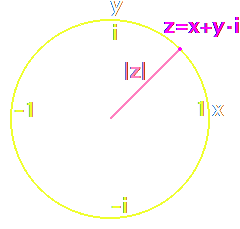
Given the periodicity of $i$'s integer exponents, the complex plane is a two-dimensional number set whose exponential nature is rotational
-
Complex numbers are similar to vectors, having both a magnitude and direction
-
The imaginary unit $i$ represents the number $1$ rotated $\pi/2$ radians in the positive direction, and it has a magnitude of $1$
-
Powers of $i$ result similarly to radians on the unit circle with each $1$ being $\pi/2$ radians
-
Following the unit circle, non-integer powers for $i^x$ extend into complex numbers with multipliers of $1$ and $i$ as components
-
It follows that $i^x$ is a two-component number on the unit circle equal to $\cos(x\cdot\pi/2)+i\cdot\sin(x\cdot\pi/2)$, sometimes represented as $\text{cis}(x\cdot\pi/2)$
Examples
$$\sqrt{i}=\cos\bigg(\frac{\pi}{4}\bigg)+i\cdot\sin\bigg(\frac{\pi}{4}\bigg)=\frac{1}{\sqrt{2}}+\frac{1}{\sqrt{2}}\cdot i$$
$$i^{5/3}=\cos\bigg(\frac{5\cdot\pi}{6}\bigg)+i\cdot\sin\bigg(\frac{5\cdot\pi}{6}\bigg)=-\frac{\sqrt{3}}{2}+\frac{1}{2}\cdot i$$