2.3.1 Cancellation
In a
factored function, like terms in both a numerator and denominator as multipliers reduce to 1
$$\frac{a(x)\cdot f(x)}{a(x)\cdot g(x)}=\frac{f(x)}{g(x)}$$
Examples
$$\frac{(x-4)\cdot (x+2)}{(x-4)\cdot (x-2)}=\frac{(x+2)}{(x-2)}$$
$$\frac{(x-4)\cdot (x+2)}{(4-x)\cdot (x-2)}=-\frac{(x+2)}{(x-2)}$$
2.3.2 Quadratic Equations Definition
Second degree trinomial equations in the standard form
$$a\cdot x^2+b\cdot x+c=0$$
The following is a more useful
general form
$$y=a\cdot x^2+b\cdot x+y_∘$$
2.3.3 Composite Quadratic Equations Factored
Quadratic equations can be thought of as the product of two linear equations and are always factorable into linear terms
$$a\cdot c\cdot x^2 \pm (a\cdot d+b\cdot c)\cdot x+b\cdot d$$
$$=(a\cdot x \pm b)(c\cdot x \pm d)$$
2.3.4 Prime Quadratic Equations Factored (Completing the Square)
The
leading coefficient must be 1, otherwise the equation must be multiplied for it to be 1. Using the
general form
$$x^2 \pm b\cdot x+y_∘=y$$
Add ${(b/2)}^2$ and subtract $y_∘$
$$x^2 \pm b\cdot x+ {\Big(\frac{b}{2} \Big)}^2=y-y_∘+{\Big(\frac{b}{2} \Big)}^2$$
Factor
$$\frac{{(2\cdot x \pm b)}^2}{4}=y-y_∘+\frac{b^2}{4}$$
2.3.5 Quadratic Formula
The
general solutions of $y=a\cdot x^2+b\cdot x+y_∘$ are
$$x=\frac{-b \pm \sqrt{b^2+4\cdot a\cdot (y-y_∘)}}{2\cdot a},\medspace a≠0$$
Proof
Given the general formula, subtract $y_∘$ from both sides
$$y-y_∘=a\cdot x^2+b\cdot x$$
Multiply by $4\cdot a$
$$4\cdot a\cdot (y-y_∘)=4\cdot a^2\cdot x^2+4\cdot a\cdot b\cdot x$$
Add $b^2$, then factor the right, similar to completing the square
$$b^2+4\cdot a\cdot (y-y_∘)={(2\cdot a\cdot x+b)}^2$$
Take the square root
$$\pm \sqrt{b^2+4\cdot a\cdot (y-y_∘)}=2\cdot a\cdot x+b$$
Subtract $b$, and divide by $2\cdot a$
Example
Solve for $x$ and $y$
$$x+y=1\medspace\land\medspace x\cdot y=1$$
Isolate $y$ in the first equation
$$y=1-x$$
Substitute for $y$ in the second equation
$$x\cdot (1-x)=1$$
Expand
$$x-x^2=1$$
Rearrange into a standard
quadratic equation
$$-x^2+x-1=0$$
Negate
$$x^2-x+1=0$$
Use the quadratic formula to find the zeros of $x$
$$x=\frac{-(-1) \pm \sqrt{(-1)^2-4\cdot 1\cdot 1}}{2\cdot 1}$$
Simplify in expanded form
$$x=\frac{1}{2}\pm\frac{\sqrt{3}}{2}\cdot i$$
Substitute for $x$ in the first equation with $y$ isolated
$$y=1-\bigg(\frac{1}{2}\pm\frac{\sqrt{3}}{2}\cdot i\bigg)$$
Simplify in expanded form
$$y=\frac{1}{2}\mp\frac{\sqrt{3}}{2}\cdot i$$
The solutions for $(x,y)$ are
$$\bigg(\frac{1}{2}\pm\frac{\sqrt{3}}{2}\cdot i,\frac{1}{2}\mp\frac{\sqrt{3}}{2}\cdot i\bigg)$$
2.3.6 Discriminant of a Quadratic Formula
$$Δ=b^2-4\cdot a\cdot y_∘$$
- If $Δ>0$, the equation has two real factorable roots
- If $Δ=0$, the equation has one factorable root squared
- If $Δ \lt 0$, the equation has two complex factorable roots
2.3.7 Cubic Formula 🔧
Discriminant
$$\Delta=b^2\cdotp c^2-4\cdotp a\cdotp c^3-4\cdotp b^3\cdotp d-27\cdotp a^2\cdotp d^2+18\cdotp a\cdotp b\cdotp c\cdotp d$$
- If $\Delta>0$, the equation has three real factorable roots
- If $\Delta=0$, the equation has one factorable root either squared or cubed
- If $\Delta\lt 0$, the equation has one real and two complex factorable roots
Proof
2.3.8 Sum & Difference of Powers
Sum of Powers for Real Roots (Odd Exponents Only)
$$a^n+b^n=(a+b)(a^{n-1}-a^{n-2}\cdotp b+a^{n-3}\cdotp b^2-...+a^2\cdotp b^{n-3}-a\cdotp b^{n-2}+b^{n-1}), \forall 2\cdotp n-1 \isin \N$$
Difference of Powers for Real Roots
$$a^n-b^n=(a-b)(a^{n-1}+a^{n-2}\cdotp b+a^{n-3}\cdotp b^2+...+a^2\cdotp b^{n-3}+a\cdotp b^{n-2}+b^{n-1}), \forall 2\cdotp n \isin \N$$
Sum & Difference of Squares & Cubes
$$a^2+b^2=(a+i\cdotp b)(a-i\cdotp b)$$
$$a^2-b^2=(a+b)(a-b)$$
$$a^3 \pm b^3=(a \pm b)(a^2\mp a\cdotp b+b^2)$$
Other Sums & Differences of Interest
$$a^4-b^4=(a+i\cdotp b)(a-i\cdotp b)(a+b)(a-b)$$
$$a^6+b^6=(a^2+b^2)(a^4-a^2\cdotp b^2+b^4)$$
$$a^{10}+b^{10}=(a^2+b^2)(a^8-a^6\cdotp b^2+a^4\cdotp b^4-a^2\cdotp b^6+b^8)$$
Example
$$x^3=8$$
Factor 8 to find the real solution
$$x^3=2^3$$
Given the equality, subtract $2^3$
$$x^3-2^3=0$$
Substitute the difference of cubes
$$(x-2)(x^2+2\cdot x+2^2)=0$$
Find the zeros of $x$ for the second term with the
quadratic formula
$$x=\frac{-2\pm\sqrt{4-4\cdot 1\cdot 4}}{2}$$
Simplify
$$x=-1\pm\sqrt{-3}$$
The solutions for $x^3=8$ are
$$\{2,-1+i\cdot\sqrt{3},-1-i\cdot\sqrt{3}\}$$
2.3.9 Pascal's Triangle
Each number in the given 'triangle' below the first is the sum of the numbers diagonally above it
|
|
|
|
|
|
|
1 |
|
|
|
|
|
|
|
|
|
|
|
|
|
1 |
|
1 |
|
|
|
|
|
|
|
|
|
|
|
1 |
|
2 |
|
1 |
|
|
|
|
|
|
|
|
|
1 |
|
3 |
|
3 |
|
1 |
|
|
|
|
|
|
|
1 |
|
4 |
|
6 |
|
4 |
|
1 |
|
|
|
|
|
1 |
|
5 |
|
10 |
|
10 |
|
5 |
|
1 |
|
|
|
1 |
|
6 |
|
15 |
|
20 |
|
15 |
|
6 |
|
1 |
|
| 1 |
|
7 |
|
21 |
|
35 |
|
35 |
|
21 |
|
7 |
|
1 |
2.3.A Binomials
Binomial Coefficient
$$ \binom{n}{k}=\frac{n!}{(n-k)!\cdot k!}=\frac{n\cdot (n-1)(n-2)...(n-k+1)}{k!}$$
Binomial Theorem
The coefficients in the expanded form match the line $n+1$ down from the top on
Pascal’s triangle
$${(x+y)}^n=\binom{n}{0}\cdot x^n+\binom{n}{1}\cdot x^{n-1}\cdot y+\binom{n}{2}\cdot x^{n-2}\cdot y^2+...+\binom{n}{n}\cdot y^n, \forall n \isin \Z$$
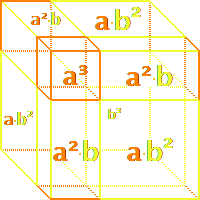
Binomials Squared & Cubed
$${(a \pm b)}^2=a^2 \pm 2\cdot a\cdot b+b^2$$
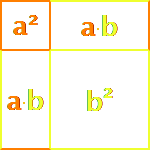
$${(a \pm b)}^3=a^3 \pm 3\cdot a^2\cdot b+3\cdot a\cdot b^2 \pm b^3$$
2.3.B Equating Coefficients (Coefficient Method of Solving)
In polynomial equations with matching factors, orders, and results, variable coefficients can be equated for solving
$$a\cdot x+b\cdot y=13\medspace\land\medspace 4\cdot x+3\cdot y=13$$
$$a=4 \qquad b=3$$
$$a\cdot x+b\cdot y=m\medspace\land\medspace (n-1)\cdot x+\frac{p}{2}\cdot y=m$$
$$a=(n-1) \qquad b=p/2$$
2.3.C Polynomial Long Division
Given the rational function $N(x)/D(x)$, the division results in the equality $N(x)=D(x)\cdot Q(x)+R(x)$, or
$$\begin{array}{r}
Q(x)+R(x)\\
D(x){\overline{\smash{\big)}\,N(x)}}\phantom{+R(x)}\\
\end{array}$$
Solving by Example
Given $(x^3+2\cdot x^2+12)/(x–2)$, express in the following form with the missing (zero coefficient) terms included
$$\begin{array}{r}
x-2{\overline{\smash{\big)}\,x^3+2\cdot x^2+0\cdot x+12}}\\
\end{array}$$
Multiply the divisor with the coefficient and variable order necessary to cancel the first term with subtraction, meaning the sign must match, in this case $x^2$
$$\begin{array}{r}
x^2\phantom{+0\cdot x+12}\\
x-2{\overline{\smash{\big)}\,x^3+2\cdot x^2+0\cdot x+12}}\\
\phantom{0}-x^3+2\cdot x^2\phantom{+0\cdot x+12}\\
{\overline{\phantom{-x^3+}4\cdot x^2+0\cdot x+12}}\\
\end{array}$$
Repeat the process
$$\begin{array}{r}
x^2+4\cdot x\phantom{+12}\\
x-2{\overline{\smash{\big)}\,x^3+2\cdot x^2+0\cdot x+12}}\\
\phantom{0}-x^3+2\cdot x^2\phantom{+0\cdot x+12}\\
\overline{\phantom{-x^3+}4\cdot x^2+0\cdot x+12}\\
\phantom{0}-4\cdot x^2+8\cdot x\phantom{+12}\\
\overline{\phantom{-4\cdot x^2+}8\cdot x+12}\\
\end{array}$$
Keep repeating until the first term no longer applies
$$\begin{array}{r}
Q=x^2+4\cdot x+\phantom{0}8\\
x-2{\overline{\smash{\big)}\,x^3+2\cdot x^2+0\cdot x+12}}\\
\phantom{0}-x^3+2\cdot x^2\phantom{+0\cdot x+12}\\
\overline{\phantom{-x^3+}4\cdot x^2+0\cdot x+12}\\
\phantom{0}-4\cdot x^2+8\cdot x\phantom{+12}\\
{\overline{\phantom{-4\cdot x^2+}8\cdot x+12}}\\
-8\cdot x+16\\
R=\overline{\phantom{-8\cdot x}+28}\\
\end{array}$$
Substitute the values for $N(x)=D(x)\cdot Q(x)+R(x)$
$$x^3+2\cdot x^2+12=(x-2)(x^2+4\cdot x+8)+28$$
2.3.D Synthetic Division
The example in
polynomial long division can be formatted as follows, with the number to the left of the line as the negative of the constant in $D(x)$, and the numbers to the right $(1\cdot x-n)$ being the coefficients and constant of $N(x)$.
$$
\frac{(x^3+2\cdot x^2+12)}{(x–2)}→
\begin{array}{c}
2\thickspace |\thickspace 1\thickspace 2\thickspace 0\thickspace 12 \\
\phantom{2}\thickspace |\underline{\thickspace \phantom{1\thickspace 2\thickspace 0\thickspace 12}}
\end{array}
$$
In this format, the first number is always copied to the last row
$$
\begin{array}{c}
2\thickspace |\thickspace 1\thickspace 2\thickspace 0\thickspace 12 \\
\phantom{2}\thickspace |\underline{\thickspace \phantom{1\thickspace 2\thickspace 8\thickspace 16}} \\
\phantom{2\thickspace |}\thickspace 1\thickspace \phantom{4\thickspace 8\thickspace 28} \\
\end{array}
$$
The number on the bottom is then multiplied by the divisor, and the result is added to the next column
$$
\begin{array}{c}
2\thickspace |\thickspace 1\thickspace 2\thickspace 0\thickspace 12 \\
\phantom{2}\thickspace |\underline{\thickspace \phantom{1}\thickspace 2\thickspace \phantom{8\thickspace 16}} \\
\phantom{2\thickspace |}\thickspace 1\thickspace 4\thickspace \phantom{8\thickspace 28} \\
\end{array}
$$
The process is repeated until every column is filled
$$
\begin{array}{c}
2\thickspace |\thickspace 1\thickspace 2\thickspace 0\thickspace 12 \\
\phantom{2}\thickspace |\underline{\thickspace \phantom{1}\thickspace 2\thickspace 8\thickspace 16} \\
\phantom{2\thickspace |}\thickspace 1\thickspace 4\thickspace 8\thickspace 28 \\
\end{array}
$$
The result is the coefficients of $Q(x)$ with the last number being $R(x)$
Example
Factor $x-1$ from $x^5-1$
$$
\begin{array}{c}
1\thickspace |\thickspace 1\enspace 0\enspace 0\enspace 0\enspace 0\thickspace -1 \\
\phantom{1}\thickspace |\underline{\thickspace \phantom{1}\enspace 1\enspace 1\enspace 1\enspace 1\thickspace \phantom{-}1} \\
\phantom{1\thickspace |} \thickspace 1\enspace 1\enspace 1\enspace 1\enspace 1\thickspace \phantom{-}0 \\
\end{array}
$$
Starting with the coefficient for $x^4$, and ending with a remainder of $0$,
$$x^5-1=(x-1)(x^4+x^3+x^2+x+1)$$
2.3.E Partial Fractions Solves
Partial Fraction Decomposition
Given the rational function $N(x)/D(x)$, expand by the smallest possible roots of the denominator
1) Linear roots are treated as follows
$$\frac{N(x)}{(x+a)(x+b)}=\frac{A}{x+a}+\frac{B}{x+b}$$
2) Quadratic roots are treated as follows
$$\frac{N(x)}{a\cdot x^2+b\cdot x+c}=\frac{A\cdot x+B}{a\cdot x^2+b\cdot x+c}$$
3) Repeated roots are treated as follows
$$\frac{N(x)}{{D(x)}^P}=\frac{A}{D(x)}+\frac{B}{{D(x)}^2}+...+\frac{C}{{D(x)}^P}$$
Example
$$\frac{5\cdot x}{(x-1)(x^2+2){(x+7)}^2}=\frac{A}{x-1}+\frac{B\cdot x+C}{x^2+2}+\frac{D}{x+7}+\frac{E}{{(x+7)}^2}$$
Solving by Example
$$\frac{12\cdot x}{x^2-10\cdot x+16}$$
Factor
$$\frac{12\cdot x}{(x-8)(x-2)}$$
Decompose
$$\frac{12\cdot x}{(x-8)(x-2)}=\frac{A}{x-8}+\frac{B}{x-2}$$
Multiply by the factored denominator
$$12\cdot x=(x-2)\cdot A+(x-8)\cdot B$$
Enter values for $x$ to cancel terms
$$x=2 \medspace\therefore\medspace 12\cdot 2=0\cdot A-6\cdot B \medspace\therefore\medspace B=-4$$
$$x=8 \medspace\therefore\medspace 12\cdot 8=6\cdot A+0\cdot B \medspace\therefore\medspace
A=16$$
Substitute $A$ and $B$ to solve
$$\frac{12\cdot x}{(x-8)(x-2)}=\frac{16}{x-8}-\frac{4}{x-2}$$