5.4.1 Arithmetic Properties
Constant Rule
$$\frac{d}{dx}(C)=0$$
Constant Multiple Rule
$$\frac{d}{dx}(C\cdot f(x))=C\cdot \frac{d}{dx}f(x)$$
Sum & Difference Rules
$$\frac{d}{dx}\big(f(x)\pm g(x)\big)=f'(x)\pm g'(x)$$
5.4.2 Product Rule
$$\frac{d}{dx}\big(f(x)\cdot g(x)\big)=f'(x)\cdot g(x)+f(x)\cdot g'(x)$$
Proof
Insert the product expression into the
derivative function
$$\lim\limits_{\Delta x\to 0}\frac{f(x+\Delta x)\cdot g(x+\Delta x)-f(x)\cdot g(x)}{\Delta x}$$
Add $f(x+\Delta x)\cdot g(x)$ minus itself into the numerator
$$\lim\limits_{\Delta x\to 0}\frac{f(x+\Delta x)\cdot g(x+\Delta x)+f(x+\Delta x)\cdot g(x)-f(x+\Delta x)\cdot g(x)-f(x)\cdot g(x)}{\Delta x}$$
Separate the fraction and apply the
limit of sums property
$$\lim\limits_{\Delta x\to 0}\bigg(\frac{f(x+\Delta x)\cdot g(x+\Delta x)-f(x+\Delta x)\cdot g(x)}{\Delta x}\bigg)+\lim\limits_{\Delta x\to 0}\bigg(\frac{f(x+\Delta x)\cdot g(x)-f(x)\cdot g(x)}{\Delta x}\bigg)$$
Factor each term to isolate derivative functions
$$\lim\limits_{\Delta x\to 0}\bigg(f(x+\Delta x)\cdot\frac{g(x+\Delta x)-g(x)}{\Delta x}\bigg)+\lim\limits_{\Delta x\to 0}\bigg(g(x)\cdot\frac{f(x+\Delta x)-f(x)}{\Delta x}\bigg)$$
Rewrite in terms of derivatives
$$\bigg(\lim\limits_{\Delta x\to 0}f(x+\Delta x)\bigg)\cdot\bigg(\frac{d}{dx}g(x)\bigg)+\bigg(\lim\limits_{\Delta x\to 0}g(x)\bigg)\cdot\bigg(\frac{d}{dx}g(x)\bigg)$$
Solve the limits
5.4.3 Quotient Rule
$$\frac{d}{dx}\bigg(\frac{f(x)}{g(x)}\bigg)=\frac{g(x)\cdot f'(x)-f(x)\cdot g'(x)}{g(x)^2}$$
Proof
Insert the quotient expression into the
derivative function
$$\lim\limits_{\Delta x\to 0}\frac{1}{\Delta x}\cdot\bigg(\frac{f(x+\Delta x)}{g(x+\Delta x)}-\frac{f(x)}{g(x)}\bigg)$$
Factor
$$\lim\limits_{\Delta x\to 0}\frac{f(x+\Delta x)\cdot g(x)-f(x)\cdot g(x+\Delta x)}{g(x)\cdot g(x+\Delta x)}$$
Add $f(x)\cdot g(x)$ minus itself into the numerator
$$\lim\limits_{\Delta x\to 0}\frac{f(x+\Delta x)\cdot g(x)+f(x)\cdot g(x)-f(x)\cdot g(x)-f(x)\cdot g(x+\Delta x)}{g(x)\cdot g(x+\Delta x)}$$
Separate the fraction and apply the
limit of sums property
$$\lim\limits_{\Delta x\to 0}\frac{f(x+\Delta x)\cdot g(x)-f(x)\cdot g(x)}{g(x)\cdot g(x+\Delta x) \cdot\Delta x}+\lim\limits_{\Delta x\to 0}\frac{f(x)\cdot g(x)-f(x)\cdot g(x+\Delta x)}{g(x)\cdot g(x+\Delta x)\cdot\Delta x}$$
Cancel $g(x)$ in the first term
$$\lim\limits_{\Delta x\to 0}\frac{f(x+\Delta x)-f(x)}{g(x+\Delta x) \cdot\Delta x}+\lim\limits_{\Delta x\to 0}\frac{f(x)\cdot g(x)-f(x)\cdot g(x+\Delta x)}{g(x)\cdot g(x+\Delta x)\cdot\Delta x}$$
Factor a negative from the second term
$$\lim\limits_{\Delta x\to 0}\frac{f(x+\Delta x)-f(x)}{g(x+\Delta x) \cdot\Delta x}-\lim\limits_{\Delta x\to 0}\frac{f(x)\cdot g(x+\Delta x)-f(x)\cdot g(x)}{g(x)\cdot g(x+\Delta x)\cdot\Delta x}$$
Factor each term to isolate derivative functions
$$\lim\limits_{\Delta x\to 0}\bigg(\frac{1}{g(x+\Delta x)}\cdot\frac{f(x+\Delta x)-f(x)}{\Delta x}\bigg)-\lim\limits_{\Delta x\to 0}\bigg(\frac{f(x)}{g(x)\cdot g(x+\Delta x)}\cdot\frac{g(x+\Delta x)-g(x)}{\Delta x}\bigg)$$
Rewrite in terms of derivatives
$$\lim\limits_{\Delta x\to 0}\bigg(\frac{1}{g(x+\Delta x)}\bigg)\cdot\bigg(\frac{d}{dx}f(x)\bigg)-\lim\limits_{\Delta x\to 0}\bigg(\frac{f(x)}{g(x)\cdot g(x+\Delta x)}\bigg)\cdot\bigg(\frac{d}{dx}g(x)\bigg)$$
Solve the limits
$$\frac{1}{g(x)}\cdot\frac{d}{dx}f(x)-\frac{f(x)}{g(x)^2}\cdot\frac{d}{dx}g(x)$$
Factor
5.4.4 Power Rule
$$\frac{d}{dx}x^n=n\cdot x^{n-1},\medspace \forall x\isin\R$$
Proof
Insert the exponential expression into the
derivative function
$$\frac{d}{dx}x^n=\lim\limits_{\Delta x\to 0}\frac{(x+\Delta x)^n-x^n}{\Delta x}$$
Apply
binomial expansion to the numerator
$$\frac{d}{dx}x^n=\lim\limits_{\Delta x\to 0}\Bigg(\frac{1}{\Delta x}\cdot\binom{n}{1}\cdot x^{n-1}\cdot\Delta x+\binom{n}{2}\cdot x^{n-2}\cdot\Delta x^2+...+\binom{n}{n}\cdot\Delta x^n\Bigg)$$
Simplify
$$\frac{d}{dx}x^n=\lim\limits_{\Delta x\to 0}\Bigg(\binom{n}{1}\cdot x^{n-1}+\binom{n}{2}\cdot x^{n-2}\cdot\Delta x+...+\Delta x^{n-1}\Bigg)$$
Solve the limit
$$\frac{d}{dx}x^n=\binom{n}{1}\cdot x^{n-1}$$
Calculate the binomial
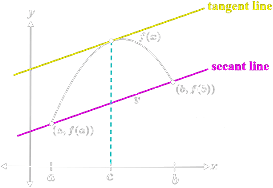
5.4.5 Mean Value Theorem for Derivatives
Within $[a,b]$, there exists a point $c$ such that $f'(c)$ is equal to the function's
average rate of change
$$f'(c)=\frac{f(b)-f(a)}{b-a}$$
5.4.6 Implicit Differentiation (Chain Rule)
$$\frac{d}{dx}f\big(g(x)\big)=f'\big(g(x)\big)\cdot g'(x)$$
$$\frac{dy}{dx}=\frac{dy}{du}\cdot\frac{du}{dx}$$
Deductive Logic
When comparing two rates, one is dependent on the other, and therefore dependent on the variable of the other, producing a scaling effect from the original function. Multiplying the two, like in percentages of percentages, yields the total change.
For example, in his 1985 book
Calculus with Analytic Geometry, George Simmons writes, "If a car travels twice as fast as a bicycle and the bicycle is four times as fast as a walking man, then the car travels 2 × 4 = 8 times as fast as the man."
5.4.7 Derivative of an Inverse Function
$$\big(f^{-1}\big)'\big(f(x)\big)=\frac{1}{f'(x)},\medspace f'(x)\ne 0$$
Proof
Using Langrange notation for $y=f(x)$, insert the inverse expression into the
derivative function
$$(f^{-1})'(y)=\lim\limits_{\Delta y\to 0}\frac{f^{-1}(y+\Delta y)-f^{-1}(y)}{\Delta y}$$
Factor $y-y$ into the denominator
$$(f^{-1})'(y)=\lim\limits_{\Delta y\to 0}\frac{f^{-1}(y+\Delta y)-f^{-1}(y)}{y+\Delta y-y}$$
$y=f(x)\therefore f^{-1}(y)=x$. Substitute the
inverse functions and $y$ values in terms of $x$.
$$(f^{-1})'(y)=\lim\limits_{\Delta y\to 0}\frac{x+\Delta x-x}{f(x+\Delta x)-f(x)}$$
Cancel like terms
$$(f^{-1})'(y)=\lim\limits_{\Delta y\to 0}\frac{\Delta x}{f(x+\Delta x)-f(x)}$$
Apply the
reciprocal rule of division
$$(f^{-1})'(y)=1\bigg/\lim\limits_{\Delta y\to 0}\frac{f(x+\Delta x)-f(x)}{\Delta x}$$
Rewrite the derivative function in terms of its differential
5.4.8 L'Hôpital's Rule
$$\text{If }\lim\limits_{x\to a}f(x)=\text{If }\lim\limits_{x\to a}g(x)=(0\text{ or }\pm\infin)$$
$$\text{then }\lim\limits_{x\to a}\frac{f(x)}{g(x)}=\lim\limits_{x\to a}\frac{f'(x)}{g'(x)}$$
The indeterminate form $0\cdot\infin$
The rule holds when applying the
reciprocal rule of division; $x\cdot y\to y/(1/x)$, also taking into account that 0 becomes ∞ or ∞ becomes 0
The indeterminate form $\infin-\infin$
The rule holds when factoring terms into one fraction, given that ∞ is the result of division by 0
Exponential Indeterminate Forms
In the cases of $\lim_{x\to a}f(x)^{g(x)}=(1^\infin\medspace\lor\medspace 0^0\medspace\lor\medspace\infin^0)$, the
natural logarithm can be taken and equated with another limit $L$, then
antilogged
$$\lim\limits_{x\to a}g(x)\cdot\ln\big(f(x)\big)=\lim\limits_{x\to a}\frac{\ln\big(f(x)\big)}{1/g(x)}=\lim\limits_{x\to a}\frac{g(x)}{1/\ln\big(f(x)\big)}=L$$
$$\lim\limits_{x\to a}f(x)^{g(x)}=e^L$$
Proof
Lef $f'(x)$ and $g'(x)$ be continuous at $a$, and $f(a)=g(a)=0$ so that
$$\lim\limits_{x\to a}\frac{f'(x)}{g'(x)}=\frac{f'(x)}{g'(x)}$$
Apply the
mean value theorem for derivatives
$$\lim\limits_{x\to a}\frac{f'(x)}{g'(x)}=\lim\limits_{x\to a}\bigg(\frac{f(x)-f(a)}{x-a}\bigg)\bigg/\bigg(\frac{g(x)-g(a)}{x-a}\bigg)$$
Simplify
$$\lim\limits_{x\to a}\frac{f'(x)}{g'(x)}=\lim\limits_{x\to a}\frac{f(x)-f(a)}{g(x)-g(a)}$$
Evaluate the limit
$$\lim\limits_{x\to a}\frac{f'(x)}{g'(x)}=\frac{0}{0}=\frac{f(x)}{g(x)}$$
Beginning using the reciprocal rule of division yields
$$\lim\limits_{x\to a}\frac{1/f'(x)}{1/g'(x)}=\frac{\infin}{\infin}=\frac{1/f(x)}{1/g(x)}$$
5.4.9 $d/dx\thinspace e^x$
$$\frac{d}{dx}e^x=e^x$$
Proof
Insert $e^x$ into the
derivative function
$$\lim\limits_{\Delta x\to 0}\frac{e^{x+\Delta x}-e^x}{\Delta x}$$
Factor the exponential power
$$\lim\limits_{\Delta x\to 0}\frac{e^x\cdot e^{\Delta x}-e^x}{\Delta x}$$
Factor $e^x$ from the limit
$$e^x\cdot\lim\limits_{\Delta x\to 0}\frac{e^{\Delta x}-1}{\Delta x}$$
Evaluate using the
$e\thickspace$limit
5.4.A Derivative of Logarithmic Functions 🔧
$$\frac{d}{dx}=\log_b x=\big(x\cdot\ln(b)\big)^{-1}$$
$$\frac{d}{dx}\ln(x)=x^{-1}$$
$$x>0\medspace\land\medspace b\ne1$$
Proof
Given
$$\frac{d}{dx}\ln(x)$$
Define components for the derivative of an inverse function
$$f(x)=e^x\qquad f'(x)=e^x\qquad f^{-1}(x)=\ln(x)$$
Since $f\big(f^{-1}(x)\big)=e^{\ln(x)}$
$$\frac{d}{dx}\ln(x)=\frac{1}{e^{\ln(x)}}$$
Simplify
$$\frac{d}{dx}\ln(x)=\frac{1}{x}$$
Given
$$\frac{d}{dx}\log_b x$$
Apply the change of base rule with base $e$
$$\frac{d}{dx}\log_b x=\frac{d}{dx}\frac{\ln(x)}{\ln(b)}$$
Apply the constant rule
$$\frac{d}{dx}\log_b x=\frac{1}{\ln(b)}\cdot\frac{d}{dx}\ln(x)$$
Solve for $d/dx\thinspace\ln(x)$
5.4.B Derivative of Exponential Functions
$$\frac{d}{dx}b^x=b^x\cdot\ln(b)$$
Proof
Let
$$y=b^x$$
Take the
natural logarithm
$$\ln(y)=\ln(b^x)$$
Apply the
logarithms power rule
$$\ln(y)=x\cdot\ln(b)$$
Derive
$$\frac{d}{dx}\ln(y)=\frac{d}{dx}x\cdot\ln(b)$$
Apply the
chain rule to
derive the natural logarithm
$$y^{-1}\cdot\frac{dy}{dx}=\frac{d}{dx}x\cdot\ln(b)$$
Evaluate the derivative on the right
$$y^{-1}\cdot\frac{dy}{dx}=\ln(b)$$
Multiply by $y$
$$\frac{dy}{dx}=y\cdot\ln(b)$$
Substitute $b^x$ for $y$
5.4.C $d/dx\thinspace x^x$
$$\frac{d}{dx}x^x=x^x\cdot \big(1+\ln(x)\big)$$
Proof
Let
$$y=x^x$$
Take the
natural logarithm
$$\ln(y)=\ln(x^x)$$
Apply the
logarithms power rule
$$\ln(y)=x\cdot\ln(x)$$
Derive
$$\frac{d}{dx}\ln(y)=\frac{d}{dx}x\cdot\ln(x)$$
Define components of the
derivatives product rule
$$
\begin{matrix}
f(x)=x & g(x)=\ln(x) \\
f'(x)=1 & g'(x)=1/x
\end{matrix}
$$
Apply the
chain rule to
derive the natural logarithm, and derive the product on the right
$$\frac{1}{y}\cdot\frac{dy}{dx}=x\cdot\frac{1}{x}+\ln(x)\cdot 1=1+\ln(x)$$
Multiply by $y$
$$\frac{dy}{dx}=y\cdot\big(1+\ln(x)\big)$$
Substitute $x^x$ for $y$